Where should you enter a meme coin trade so the risk-to-reward actually works?
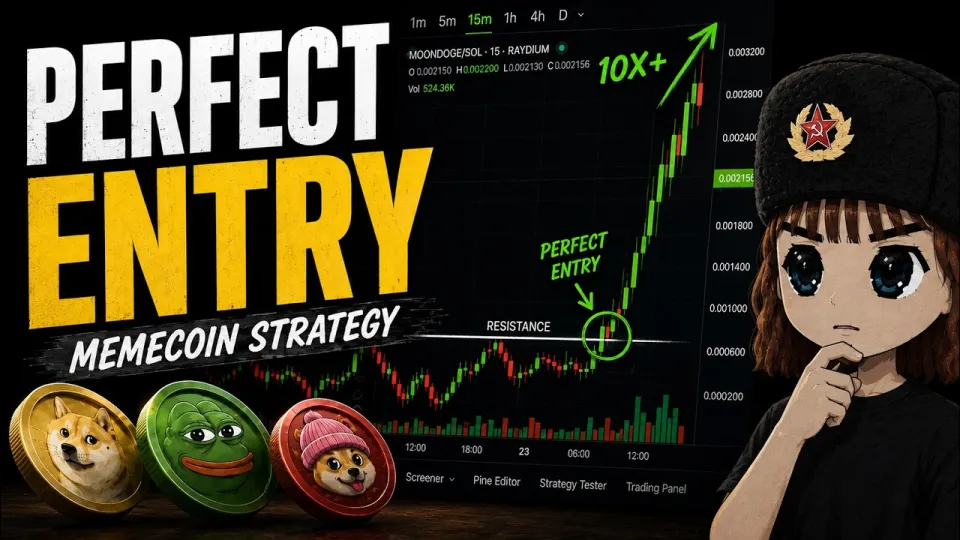
Video: How I Find the PERFECT Entry on Memecoins 📈 (Full Strategy)
Want articles like this for your own video to promote it on YouTube and Google? Order them through the Telegram bot @sat_sit_bot. It writes articles around your video, embeds the video and publishes them on popular niche websites (no ads). Your first 50 articles are free.
· based on the channel starwifpump
Key takeaways
- Most meme coin losses come from bad timing, not bad coin selection — entry price sets the whole risk-to-reward ratio.
- A valid entry needs confirmation: momentum, a pullback to support and a chart structure that has not already gone parabolic.
- Chasing a green candle is the most common mistake; waiting for a retest usually gives a tighter stop and a bigger upside.
- Every trade needs a pre-planned invalidation level, position size and profit-taking ladder before the buy order goes in.
- Signals that say skip the trade: vertical candles with no consolidation, fading volume and no clear level to put a stop under.
A meme coin entry is a timing decision, not a picking decision: you buy after momentum is confirmed and price pulls back into a defined support level, with a stop placed where the setup is invalidated. The coin itself matters far less than where you get in, because entry price determines your risk-to-reward ratio before the trade even starts. Tools that bundle charting, sniping and copy trading in one terminal — early access is available through the Plasma Telegram — make that timing work easier, but the process below is what actually decides the outcome.
Why meme coin entries fail more often than coin picks
Most meme coin traders do not lose because they chose a dead project; they lose because they bought the top of a candle that was already vertical. A meme coin can have a real narrative, an active community and fresh liquidity, and still hand you a 40% drawdown within minutes if you enter after the move has already printed. The chart, not the story, tells you whether the remaining upside is worth the stop distance.
The asymmetry is simple. Entering a breakout at the high means your invalidation level sits far below, so a normal retracement stops you out. Entering on a pullback into support means the same invalidation level sits close, so the same move that would have stopped you out now just becomes a better price. Same coin, same thesis, completely different trade.
The four conditions a meme coin chart must meet before you buy
A high-quality entry on a meme coin requires four things to line up: confirmed momentum, a pullback, a visible support level and enough liquidity to exit. If any one of them is missing, the setup is a guess rather than a trade.
- Momentum is already proven. You want to see the token make a higher high with expanding volume, not a flat chart hoping for a first pump. Momentum without chasing means you wait for the move to happen first and then look for your price.
- Price pulls back instead of extending. After the impulse, the chart should retrace into a zone — a prior consolidation, a moving average, or the level where the breakout started. A pullback that holds is confirmation; a pullback that slices through everything is a warning.
- Support is definable. You must be able to point at a price and say "below here, the idea is wrong." If you cannot draw that line, you cannot size the position.
- Liquidity supports an exit. Thin pools mean your stop is theoretical — slippage fills you far below it. Check pool depth before you plan the trade, not after.
How to time the entry without chasing the pump
The practical answer to chasing is to let the first impulse go and buy the retest. Meme coins rarely go up in a straight line forever; they print an impulse, consolidate, and then either continue or fail. Your job is to be positioned for the continuation at a price where the failure is cheap.
A repeatable sequence looks like this:
- Mark the impulse high and the base it launched from.
- Wait for the retracement into the base or the first higher-low.
- Require volume to dry up on the pullback and return on the bounce.
- Enter on the reclaim of the pullback high, not on the way down into it.
- Place the stop just under the support that defines the setup.
This is slower than buying a green candle, and that is the point. Patience is the edge: the setup either comes to you or it does not, and skipping a bad entry costs nothing.
Chart signals that tell you not to enter
Knowing when to skip a meme coin trade protects more capital than any entry trick. Several patterns reliably precede the entries that hurt.
- Vertical candles with no consolidation. If the chart has gone parabolic without a pause, there is no structure for a stop and no natural buyer below you.
- Volume fading into a new high. Price making a higher high on declining volume is distribution, not strength.
- Repeated failed reclaims. Each rejection at the same level adds sellers and weakens the next attempt.
- No definable support. If the nearest level is 30% below spot, the trade is too expensive regardless of the narrative.
- Liquidity that cannot absorb your size. A position you cannot exit is not a position.
Planning risk, exits and profit-taking before the buy
Risk planning happens before the order, not after the drawdown. The three numbers you need are the entry, the invalidation level and the size that keeps a full stop-loss to a small, fixed percentage of your account — many traders cap a single meme coin loss at 1–2% of capital precisely because these assets can gap.
On the exit side, a ladder beats a single target. Taking a portion off at the first resistance, another at the next extension, and letting a runner ride with the stop moved to breakeven converts a volatile trade into a managed one. Meme coins can reverse violently, so partial profit-taking is not pessimism — it is how you keep the gains the chart gave you.
Common questions from newer meme coin traders
Beginners tend to ask the same handful of things, and the answers are mostly about process rather than secret indicators. Filters on trackers should screen for liquidity, age of the pool, holder distribution and volume — not for promises of a pump. Social tracking helps you see attention building, but attention alone is not an entry signal; it is context for the chart. And the mechanics are broadly similar across chains, though liquidity depth and trading costs differ, so the same setup may be worth taking on one chain and not on another.
The hardest question is the emotional one: traders who lost money want to know whether to come back. The honest answer is that returning with the same sizing and the same urgency produces the same result. Come back with a written entry checklist, a fixed risk per trade and a rule that says no setup means no trade.
Useful links
- Plasma Telegram — early access, updates and setup help
- Discord community
- Padre terminal VIP access
- Solpump
- starwifpump on X
The takeaway on meme coin entries
Entry timing is the part of meme coin trading you can actually control, and it is where most of the risk-to-reward is decided. Confirm momentum first, buy the pullback into support, define your invalidation level before sizing, and take profit in pieces. Skip the vertical candles and the fading-volume highs — no trade is a valid decision. The full strategy breakdown comes from the starwifpump channel, and the fastest way to get set up with the tools mentioned is the Plasma Telegram.
Source: How I Find the PERFECT Entry on Memecoins 📈 (Full Strategy) · Markdown version
Questions & answers
Is it better to buy a meme coin breakout or wait for a pullback?
For most traders a pullback entry is better because the invalidation level sits closer, which means a smaller loss when the setup fails and a larger upside if it works. A breakout entry can work, but only when there is a clear level to place a stop under and volume confirms the move. Buying a vertical candle with no structure is neither.
How much of my account should I risk on a single meme coin trade?
A common approach is capping a single meme coin loss at 1–2% of trading capital, because these assets can gap and slip far beyond a stop. Position size should be calculated from the distance between entry and invalidation, not chosen by feel. If the stop distance is wide, the position gets smaller.
What filters should I use on a tracker to find tradeable meme coins?
Focus on liquidity depth, pool age, holder distribution and trading volume rather than on hype metrics alone. Social attention is useful context but not an entry signal by itself. The chart still has to give you a pullback into support before anything is worth buying.
Do the same entry rules apply on every chain?
The chart logic — momentum, pullback, support, invalidation — carries over between chains, but liquidity depth, fees and execution speed differ. A setup that is tradeable on a deep pool may be too expensive to exit on a thin one. Check the mechanics of the specific chain before applying the same size.